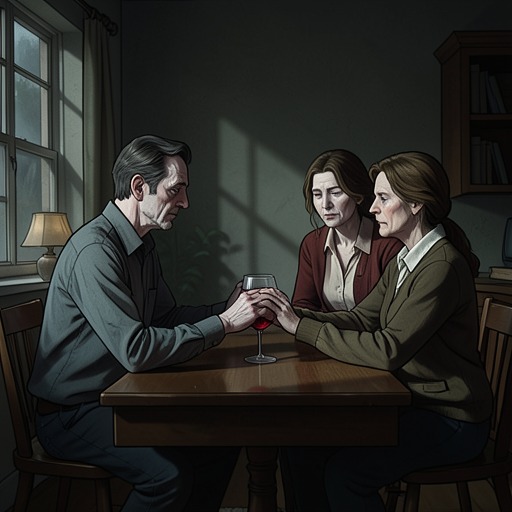
Vampires
The RadleysVampires in the novel are not defined simply by supernatural ability but by dependence on blood: the craving can overwhelm judgment, intoxicating its subject with strength and a feeling of power. The condition includes hereditary vampires and people converted from human life, and it creates a persistent divide between those attempting to abstain and those who continue to drink. That divide is at once bodily, ethical, familial, and political. Blood may sustain or endanger a vampire, but it can also establish an attachment that lasts for life.
Definition and Ways of Life
The novel’s terminology treats vampire as a familiar, romanticized name for a blood addict, whether the person drinks blood or is trying not to. An abstainer is not someone cured of the craving: abstention is described as a continual process of overcoming addiction. The struggle remains present even when the vampire has chosen a safer and more restrained life. Peter Radley explains to Rowan Radley that blood’s effects can feel energizing and powerful, but that the craving takes over rather than providing lasting satisfaction. The Handbook’s warning makes the distinction explicit: blood does not satisfy cravings; it magnifies them.
Continued drinking, by contrast, defines the Practicer. The glossary describes a converted vampire as a human who survives a vampire’s bite and then receives that vampire’s blood, becoming a blood addict in turn. It defines vampire blood, often called VB, as desirable to vampires in its own right. Unlike human blood, it keeps well enough to be bottled; human blood is not bottled for drinking. Abstainers must resist VB as well as other blood, because the desired substance remains a temptation even when obtained in a convenient, preserved form.
The distinction between abstention and practice is not presented as a simple difference in appetite. Peter remembers trying to rely on blood obtained through other means, including supplies from a hospital, while acknowledging that human blood could be most desirable fresh and that the craving could become difficult to resist. In the present, he argues that living without drinking is better, though it means feeling unwell much of the time and dying younger than they might otherwise. His account makes restraint costly rather than effortless: it is a moral choice sustained alongside addiction, not proof that the addiction has disappeared.
Dependence, Power, and Conversion
Blood’s effects give the condition its central tension. Peter tells Rowan that it can make a vampire feel unusually strong and capable, as though anything could be done or created. Such intoxication offers immediate reinforcement, while its increased craving points toward a continuing cycle rather than resolution. The Handbook’s blunt formulation condenses that cycle: drinking intensifies the desire that prompted it. In this framework, the feeling of power is not evidence of mastery; it can be part of what makes the dependency harder to resist.
The novel does not assign every vampire the same abilities. It notes that certain Unblooded Practitioners have particular talents, usually among the most amoral and dangerous, and that heavy blood consumption can enhance their mental and physical powers. Will Radley, for example, summons old forces, transforms himself, and begins blood-minding. These details establish what some vampires can do without making those capacities universal. The broader rule is variability: blood consumption, personal conduct, and exceptional talents intersect, but are not identical categories.
Conversion is presented as a serious, reciprocal act rather than a simple bite. The prospective vampire drinks the convertor’s blood after the exchange begins, and the convertor drinks the other person’s blood in turn. Will explains that conversion creates a lifelong craving for, and love toward, the vampire whose blood was given, even when the converted person understands that this attachment may be harmful. The bond complicates consent and intimacy because a relationship created through blood can outlast the feelings or judgments that would ordinarily guide it.
That consequence matters in the crisis surrounding Eve Copeland. Helen Radley warns Jared Copeland that giving Eve blood will make her a vampire and that Eve is likely to develop powerful feelings for whoever supplies it. Rowan ultimately gives Eve his blood when she is in danger; she recognizes that he is saving her. The act joins survival to conversion and care to an enduring bond. Conversion can preserve a life, but the gift also changes the relationship between giver and recipient in a way neither can treat as temporary.
Families, Secrecy, and the Everyday
Vampirism enters family life not only through conversion but through disclosure and inherited identity. When Peter finally stops Helen Radley from continuing around the truth, he looks at his daughter Clara Radley and tells her that the family are vampires. The revelation gives a name to what has been withheld, while Peter’s later explanation to Rowan frames their condition as a burden requiring restraint. His description of the family’s earlier attempts to avoid human blood supplies a history of imperfect efforts rather than a claim that they were always safe or successful.
The household’s response to vampirism also reaches into ordinary culture. A few days after moving in, Peter agrees to Helen’s proposal that the family go through their records, CDs, books, and videos, removing works by vampires, whether their subjects are hereditary or converted, living or dead, practicing or abstaining. The sweep is unusually comprehensive: it treats vampire identity as something the family must manage in its surroundings as well as in its conduct. The scene links domestic order and secrecy to an effort to distance the household from a category that describes the family itself.
For Rowan, written rules and explanations become part of confronting the condition. After listening to Meat Is Murder by the Smiths, he consults the index of The Abstainer’s Handbook and finds information on page 140. Later, he sits holding a bottle of vampire blood, then picks it up. Those concrete moments place the temptation in a private, ordinary room rather than in a public spectacle. The supplied scenes establish his attention to the bottle and his debate, while the larger significance lies in the choice abstention continually demands: resisting a substance that remains available and desirable.
Society, Protection, and Policing
Vampires are also organized beyond the family. Will tells Peter and Helen that vampires became active around the mid-1990s and formed a society to deal with the police. The Sheridan Society, based in Manchester, is described as a collective of Practicers that looks after its members. Will says that he is protected by it and that the police cannot stop him. Its reach is visible in The Black Narcissus, a Manchester nightclub run by the Society, where bottled vampire blood is sold. Will describes buying a bottle from the cloakroom attendant for twenty pounds, presenting access to blood as a commercial service operating under the Society’s protection.
The Society’s political leverage rests on a list of untouchables. These are Practicers who have committed killings and whom the police cannot pursue without risking their trust and correspondence with the Society, and therefore contact with the vampire community as a whole. The arrangement grew from the failure of a harsher approach. Police had previously used trained officers with advanced crossbow skills to eliminate vampires, who then disappeared from the record. Zero tolerance, however, rapidly increased conversion rates and raised the prospect of a large, public conflict. The police consequently combined force with conditional protection, seeking influence over some dangerous vampires by granting them immunity under rules.
That policy carries an explicit ethical cost. The police arrangement rewards some of the most notorious and bloodthirsty vampires with protection, while abstainers and less extreme blood drinkers remain unprotected. Its defenders reason that access to the Society allows police to restrain some of its members; its structure nevertheless makes protection depend on a hierarchy that can favor the most dangerous. The novel thus sets the family’s aspiration to be good against a wider system that manages risk through bargains rather than consistent justice.
The policing system is not portrayed as a secret confined to a few officers. An officer from the Unnamed Predator Unit tells a superintendent that the injuries under investigation are vampire bites and identifies the unit as a nationwide countervampirism force that liaises with the vampire community. She estimates approximately seven thousand vampires across the country, while noting that mobility and traffic between European cities make a precise count difficult. London, Manchester, and Edinburgh have the United Kingdom’s highest per-capita rates. Her matter-of-fact explanation contrasts with Peter’s earlier recollection that the police had not officially acknowledged vampires, showing the scale of the institutional relationship without suggesting that the ethical and practical conflicts have been resolved.
Narrative Significance
Vampirism connects private appetite to public power. In the Radley household, the condition demands secrecy, explanation, and repeated acts of restraint; in conversion, it can bind people through a life-changing exchange of blood; in the wider world, it has produced a society capable of bargaining with the police. These scales are linked by the same substance. Blood can offer immediate strength, sustain a Practicer’s market, intensify dependency, or create a lasting attachment, while refusing it means accepting discomfort and continued vulnerability to craving.
The contrast between Peter’s account of abstention and Will’s confidence in protection prevents vampire identity from settling into one moral type. Some vampires try to live safely; others continue to drink and benefit from an institutional shield. The novel’s definition therefore remains social as well as bodily: what a vampire is depends not only on origin or appetite, but on how that appetite is managed, what obligations blood exchange creates, and which powers are willing to protect the person who gives in to it.